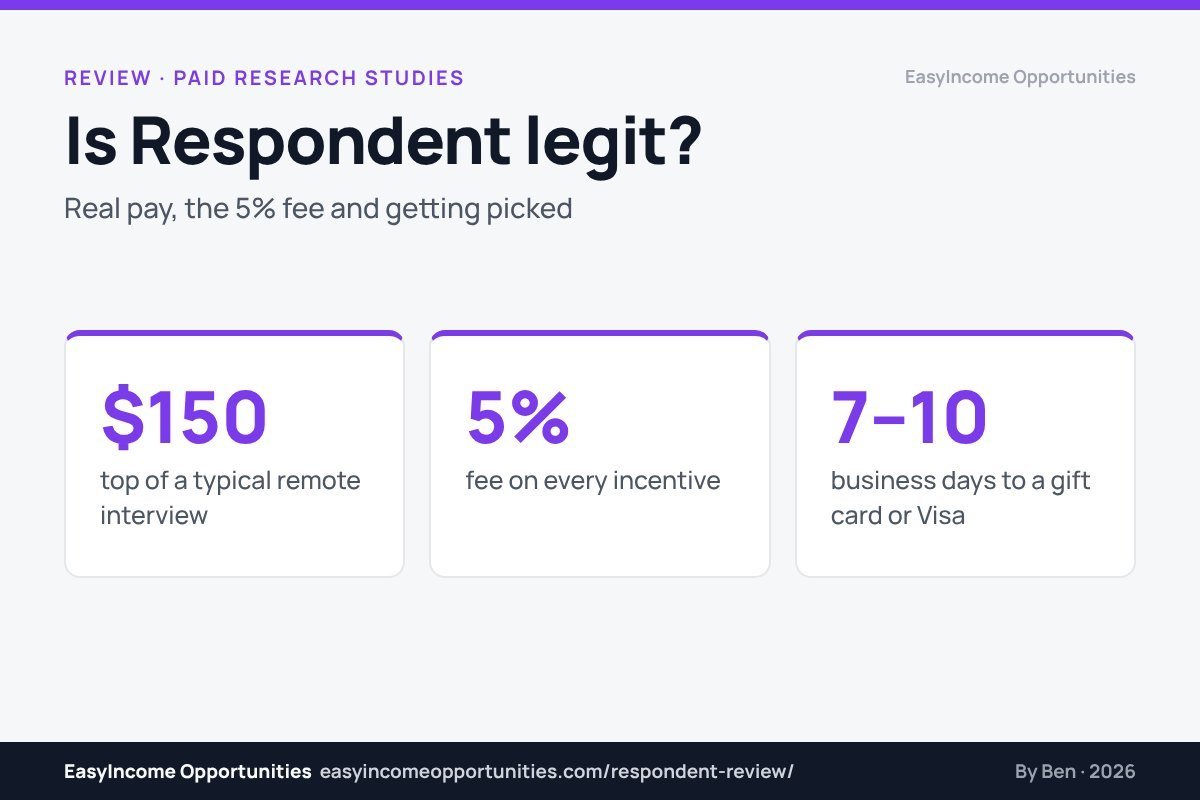
Is Respondent legit? Yes. Respondent (respondent.io) is a New York research-recruitment company that pays people to join interviews, focus groups and short tasks for companies such as Microsoft and Stripe, and says it has paid out more than $36 million. Joining is free and the pay per study is among the best in the side-hustle world. But there are three things most reviews leave out: Respondent takes a 5% fee from every payment, it now pays only in gift cards and prepaid Visa through Tremendous, and whether you get paid depends on the researcher marking you as attended. This Respondent review covers all three.
Verdict in 20 seconds
Respondent is a real, well-run platform where one accepted study can pay $40 to $150 for an hour of your time, and senior professionals can earn far more. Most applications are rejected, though, screeners are unpaid, and Respondent itself warns that it is not a dependable income. Fill in your profile properly, add LinkedIn and a work email, apply widely, and treat every accepted study as a bonus.
KEY TAKEAWAYS
- Respondent says it has 4.3 million verified participants and had paid more than $36 million in incentives by December 2025 (Respondent, Respondent blog).
- Typical pay: about $40–$150 for a 30–90 minute remote interview, $5–$25 for a short unmoderated task, $75–$250+ for in-person sessions (Respondent help center).
- Every incentive is reduced by a 5% processing fee, minimum $1: a $95 study pays $90.25 (Respondent help center).
- Since May 2025 payouts go through Tremendous (gift cards or a prepaid Visa), usually 7–10 business days after the researcher confirms you attended (Respondent, Respondent).
- Screeners are unpaid and the researcher, not Respondent, decides who is invited; invitations can take 5–8 days (Respondent help center).
- Respondent says scammers never ask you to pay, buy gift cards, install remote-desktop software or upload ID outside the platform (Respondent).
1What is Respondent, and who runs it?
Respondent is a marketplace that connects researchers with people who match a study’s profile, from parents and gamers to IT managers and nurses. The US company is Respondent, Inc., with a New York address in its terms, and an Australian sister company in Sydney (Respondent terms). Its CEO and co-founder, Jack Pratten, has described how the company started by recruiting people “on the streets of New York” before building the platform out from 2017 (Respondent).
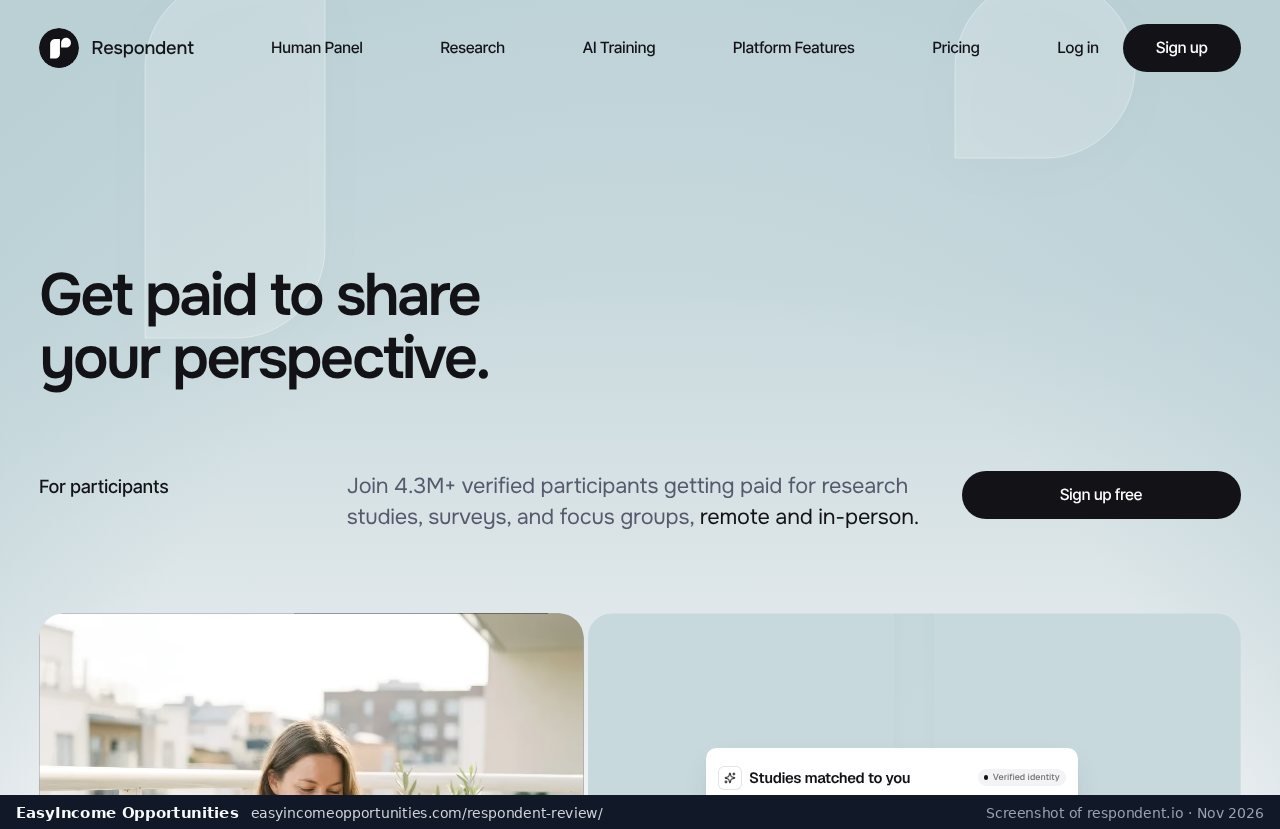
The scale is real. Respondent passed 4 million verified participants in December 2025 and reported “36M+ total incentives paid” and more than 20,000 participants paid every month (Respondent blog). Its participant page names Anthropic, Microsoft, Dropbox, GoDaddy and Stripe among the companies running studies, and its security page claims an independently audited SOC 2 Type II report plus GDPR and CCPA compliance (Respondent, Respondent). Like most research platforms in 2026, it now also sells AI training work such as model evaluation and red-teaming (Respondent).
2How Respondent works for participants
Sign-up is free and takes a few minutes; you must be 18 or older (Respondent terms). Verifying your phone by SMS and your email unlocks consumer studies. Adding a verified work email on a company domain (not Gmail or Outlook) unlocks the better-paid B2B studies, and that work email is re-checked every 90 days (Respondent help center).
- Profile: a profile photo is listed as required, and LinkedIn is optional but “especially valuable” because researchers check it before inviting you (Respondent, Respondent).
- Screeners: each project asks 2 to 20 unpaid questions, and some add a second screener on a partner’s site (Respondent). There is a daily screener limit, though Respondent doesn’t publish the number (Respondent).
- Selection: the researcher reviews applicants and picks who to invite; Respondent says it “never selects, screens, or disqualifies Participants”, and an invitation can take 5 to 8 days (Respondent).
- Study types: remote one-to-one interviews (usually 15–90 minutes), remote focus groups, unmoderated surveys and tasks, diary studies and in-person sessions (Respondent).
One rule catches people out: if you edit your profile, the changed fields lock for seven days, so you can’t tailor your job title to each project (Respondent). Researchers can also disqualify you for AI-generated answers or for applying to several near-identical projects (Respondent).
3How much does Respondent pay in 2026?
Researchers set the incentive, and you see it before you apply. Respondent’s own help center gives these typical ranges (Respondent help center):
| Metric | Value | Source |
|---|---|---|
| Remote interview, 30–90 min | about $40–$150 | Respondent |
| Unmoderated task, 5–25 min | about $5–$25 | Respondent |
| Diary study | about $50–$200+ | Respondent |
| In-person session, 60–120 min | about $75–$250+ | Respondent |
| Senior B2B roles (marketing claim) | “regularly” $400+ | Respondent |
Ranges from Respondent’s help center, checked November 4, 2026. They are illustrative; each project shows its own incentive.
What a $100 study actually pays you (USD)
Calculated from Respondent’s 5% (minimum $1) processing fee.
The marketing page is more upbeat than the help center: it says “most sessions pay $50–$250” (Respondent), while the help center starts at $5 for short unmoderated tasks. The help center is also blunt about volume, saying earnings are “not guaranteed or daily” and should not be treated as a dependable income (Respondent help center). The participant page itself says most people get one to three invitations a month (Respondent).
4The 5% fee and how you get paid
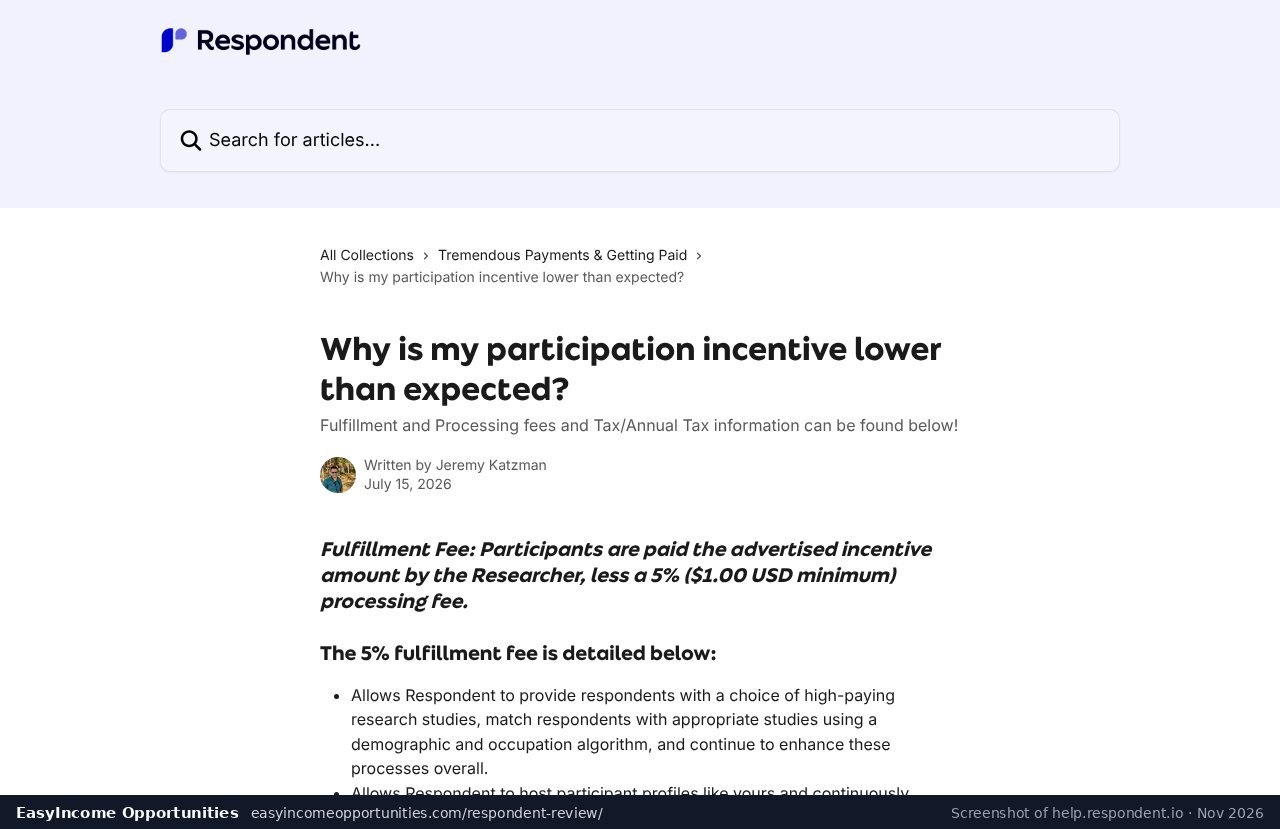
Respondent deducts a processing fee from every incentive: “5% ($1.00 USD minimum)”. Its own examples: $20 becomes $19, $95 becomes $90.25 and $300 becomes $285 (Respondent help center). The terms confirm the fee is the higher of 5% or $1 and is shown before you accept a project (Respondent terms). That sits awkwardly next to the “No fees” line on the participant sign-up page (Respondent), so read it as “no fee to join”.
Payment method changed in 2025. Since a rollout that began on May 28, 2025, incentives go out through Tremendous: you get an email and pick a gift card or a prepaid virtual Visa (Respondent). If you used to take PayPal, Respondent suggests the Visa card instead (Respondent). Payment usually arrives 7–10 business days after the researcher confirms you attended, counted from that confirmation rather than the study date (Respondent). That is slower than the gigs in our list of side hustles that pay daily or weekly.
5%
is taken from every Respondent incentive, with a $1 minimum. On a $20 unmoderated task that’s 5% of your pay; on a $300 interview it’s $15. By comparison, UserTesting mentions no fee of its own on tester payouts.
5The main complaints, and what you can do
- Rarely getting picked. This is the most common frustration, and it follows from the model: one researcher picks a handful of people from many applicants. Respondent’s advice is a complete profile, a real photo, LinkedIn and a verified work email (Respondent help center).
- Payment depends on the researcher. Your attendance and incentive status are “solely at the discretion of the researcher”, and there is no formal resolution center. Message the researcher in the app first, then contact Support with screenshots; Support says it investigates within 72 business hours (Respondent help center).
- Researcher no-shows. If a researcher cancels within four hours of the session or doesn’t turn up, they still owe you the full incentive (Respondent help center).
- Forfeited incentives. The terms let you lose an incentive if a researcher decides you didn’t “satisfactorily complete” the session, if you delete your account first, or if a payment can’t be delivered for six months (Respondent terms).
Trustpilot paints a middling picture: Google’s search listing for Respondent’s Trustpilot page showed 3.8 out of 5 from roughly 1,470 reviews in early November 2026 (Trustpilot). We couldn’t load Trustpilot directly to check the breakdown, so treat that figure as approximate.
6Scams that use Respondent’s name
Because Respondent pays well, scammers copy the format. Respondent’s own safety article lists the red flags (Respondent):
- A “researcher” asks to pay you outside the platform or moves the conversation to WhatsApp or Telegram.
- You are asked to pay upfront, buy gift cards “to get reimbursed”, or buy equipment to qualify.
- You are asked to install unknown software, allow remote-desktop access, or upload your ID anywhere other than inside Respondent.
The terms also forbid researchers from contacting applicants outside the platform, and joining a session off-platform is “entirely at your own risk” (Respondent terms). Report anything suspicious to support@respondent.io.
7Taxes for US participants
Incentives are taxable income. Respondent’s terms say it may ask US participants for W-9 details once their incentives pass the reporting thresholds, and that any Form 1099-NEC reports the gross amount before the 5% fee (Respondent terms). Gift-card payments don’t change that. For payments through apps and card networks, the IRS confirmed in 2025 that the Form 1099-K threshold reverted to $20,000 (IRS), but income is taxable whether or not you receive a form.
8Is Respondent worth it in 2026?
Yes, if you have a job title or experience that researchers want and you are willing to apply to a lot of studies to land a few. One accepted interview can pay more than a week of microtasks on a site like Clickworker. It is less worth it if you want steady income, if you dislike gift-card payouts, or if your profile is generic: then most of your time goes into unpaid screeners.
Good companions: Prolific for steady academic studies, UserTesting for $10 website tests, and Dscout for diary studies (Respondent and dscout have shared participant access since November 2025, Respondent). User Interviews is a close rival, but it now belongs to UserTesting’s parent company, which bought it in January 2026 (UserTesting). If you have a degree or specialist skill, compare the hourly rates in our guide to getting paid to train AI and on expert networks like Mercor and micro1.
Respondent FAQ
Is Respondent legit or a scam?
Respondent is legit. It is a New York research-recruitment company with more than 4 million verified participants that says it has paid out over $36 million. It never charges you to join. Scammers sometimes copy its format, so never pay, buy gift cards or install remote-access software for a study.
How much does Respondent pay?
Respondent’s help center lists about $40–$150 for a 30–90 minute remote interview, $5–$25 for a short unmoderated task, $50–$200+ for diary studies and $75–$250+ for in-person sessions. A 5% fee (minimum $1) is taken from each incentive.
How does Respondent pay you?
Through Tremendous, as a gift card or prepaid virtual Visa of your choice, usually 7–10 business days after the researcher confirms you attended. Respondent moved from PayPal to Tremendous in a rollout that began in May 2025.
Why does Respondent take 5%?
Respondent deducts a processing fee of 5% of each incentive, with a $1 minimum, so a $95 study pays $90.25. The fee is shown before you accept a project.
Why am I not getting selected on Respondent?
Researchers, not Respondent, pick participants, often from many applicants. A complete profile with a photo, a linked LinkedIn account and a verified work email improves your chances, and invitations can take 5–8 days.
Is User Interviews the same company as Respondent?
No. User Interviews is a separate platform that UserTesting bought in January 2026. Respondent is independent and has partnered with dscout since November 2025.
Sources
- Respondent, Become a participant
- Respondent, Participant terms and conditions
- Respondent, Security
- Respondent, Fraud prevention
- Respondent blog, 4 million participants (Dec 2025)
- Respondent blog, interview with CEO Jack Pratten
- Respondent blog, integration with dscout (Nov 2025)
- Respondent homepage
- Respondent help, Is Respondent legit and safe?
- Respondent help, Why is my incentive lower than expected?
- Respondent help, Getting paid: timeline and redeeming
- Respondent help, Tremendous payment options
- Respondent help, Tremendous FAQs
- Respondent help, Earning with Respondent
- Respondent help, Phone and email verification
- Respondent help, Adding social media links
- Respondent help, Getting more invitations
- Respondent help, How to get selected
- Respondent help, Why can’t I edit my profile?
- Respondent help, Screeners explained
- Respondent help, Disqualifications
- Respondent help, Project types
- Respondent help, Resolving payment issues
- Respondent help, Researcher cancels or no-shows
- UserTesting, acquires User Interviews (Jan 2026)
- Trustpilot, Respondent reviews
- IRS, Form 1099-K threshold reverts to $20,000
This review is based on Respondent’s participant page, terms, security pages, blog and help center, an IRS notice, and the public Trustpilot listing, all linked in the text and checked on November 4, 2026 — see how we review. There are no affiliate links in this article. Rates, fees and payout methods change; check the linked sources for current terms. Research and drafting were AI-assisted; all facts and the final judgment are the author’s.